


Win public tenders across Europe
Get into new European markets
through public tenders
Tender evaluation
Local compliance & approvals
Tender & bid writing
Full tender support
Tell us about your tender

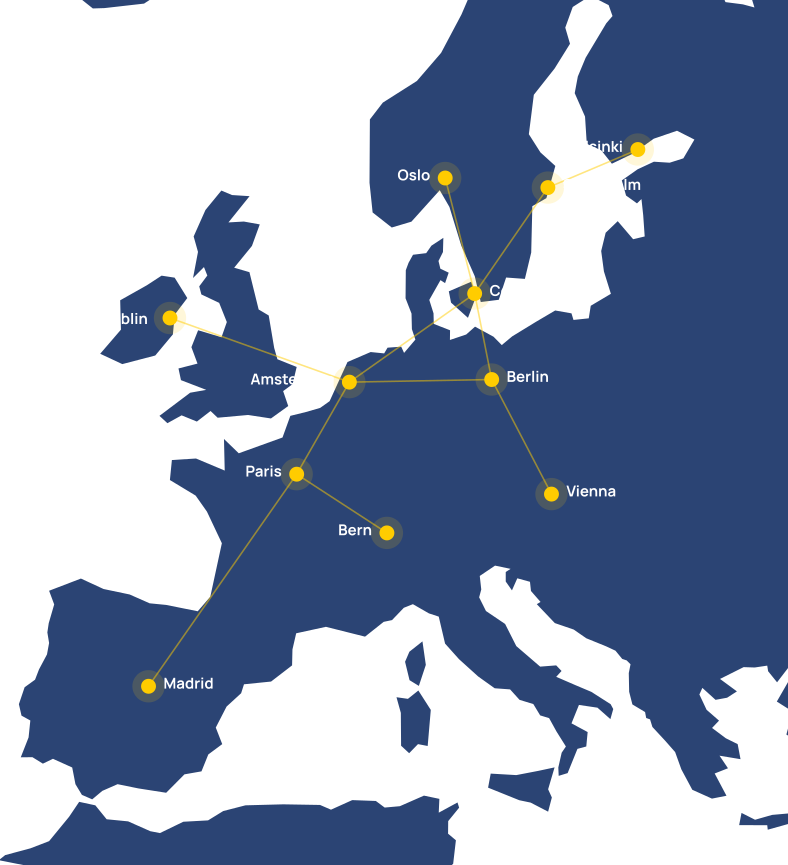
Local expertise with public tenders in the most lucrative European countries
Public tenders in Denmark
Public tenders in Denmark are published on the national portal udbud.dk, with higher-value contracts also listed Europe-wide on TED. Denmark runs one of the most digital and transparent procurement systems in Europe, governed by the Udbudsloven (Public Procurement Act), with a strong focus on sustainability and good access for smaller suppliers. Bids are normally submitted in Danish, though English is sometimes accepted for larger international tenders. Contracts are usually awarded on the best price-quality balance (MEAT), so a well-argued bid beats the cheapest one. The real hurdle for a foreign supplier is language and local framing, not the rules.
Public tenders in Sweden
Sweden is the largest procurement market in the Nordics, at roughly €70 billion a year, and is governed by the LOU (Public Procurement Act). Unusually, it has no single national portal: tenders are spread across commercial platforms such as Visma TendSign, Mercell, and e-Avrop, so you have to monitor several at once. Swedes have high English proficiency, but tender documents and bids are still expected in Swedish. Sustainability and quality criteria carry real weight in scoring, not just price. It is an open and rewarding market once you can track the fragmented portals and answer in Swedish.
Public tenders in Norway
Norway is not an EU member, but as an EEA country it follows the same European procurement rules, so companies from across Europe can bid on equal terms. Public tenders are published on the national portal Doffin, with above-threshold contracts also appearing on TED. Bids are normally in Norwegian, and quality and sustainability weigh heavily in evaluation. Norway is a high-value market, particularly in energy, infrastructure, and public services. The practical work is local language and local references, not legal access.
Public tenders in Finland
Finland publishes all public tenders on its national notice portal, Hilma, while the bids themselves are submitted on a separate platform named in each notice, such as Cloudia, Tarjouspalvelu, or Mercell. The country is officially bilingual, but in practice the documentation is in Finnish, a language unrelated to most others, which makes machine translation unreliable and local help genuinely valuable. Finnish buyers put strong weight on quality, lifecycle cost, and sustainability. Health and social care purchasing is now concentrated in a smaller number of regional “wellbeing” counties. Winning here means bidding in proper Finnish, framed around quality.
Public tenders in Germany
Germany is Europe’s largest public procurement market and also its most fragmented, split across the federal government, 16 states, and thousands of municipalities. There is no single portal: notices are spread across eVergabe, DTVP, Vergabe.de, subreport, bund.de, and many regional platforms, with above-threshold tenders also on TED. Almost everything is in German, and submission is electronic only. The formal rules (GWB, VgV, and VOB/A for construction) are strict, and a Präqualifizierung (pre-qualification) helps regular bidders move faster. The winners are suppliers who can navigate the portal patchwork and bid in correct German with local references.
Public tenders in The Netherlands
The Netherlands runs one of Europe’s most open and centralised systems: almost all public tenders go through a single mandatory portal, TenderNed. Dutch law enforces proportionality (the Gids Proportionaliteit), which keeps requirements fair for smaller and newer suppliers, and English is accepted more often here than in most markets, especially for IT and international contracts. Most contracts are awarded on best value (EMVI, the Dutch form of MEAT), not lowest price. Many larger contracts also expect a social-return commitment (SROI), often around 5% of contract value, so build that into the bid. It is one of the easier European markets for a foreign supplier to enter, but the bid still has to answer the Dutch criteria.
Public tenders in Switzerland
Switzerland is not in the EU or the EEA, so access runs through the WTO Government Procurement Agreement and its bilateral deals with the EU, and its tenders do not appear on TED. Almost everything is published on the national portal simap.ch. The country has 26 cantons and four languages, so a tender from Zurich is in German, from Geneva in French, and from Lugano in Italian, and cantonal rules vary. It is a high-value market, around CHF 40 billion a year, but the mix of federal and cantonal systems plus multiple languages makes it complex. You bid in the language of the buyer’s region, under GPA rather than EU rules.
Public tenders in Austria
Austria’s public tenders run mainly through ANKÖ and the federal Auftrag.at platform, with a central search on the business portal USP, while the central purchasing body BBG manages large multi-year frameworks. The system is known for strict procedural formalism: small mistakes in documentation or format can get a bid excluded, so precise compliance matters more than in many countries. German is mandatory throughout, with effectively no exceptions. Companies from across Europe have full access. This is a market where careful, formally correct bids win and sloppy ones get thrown out on technicalities.
Public tenders in The Republic of Ireland
The Republic of Ireland is the most accessible market on this list for one simple reason: it runs entirely in English. All public tenders are published on the national portal eTenders (etenders.gov.ie), managed by the Office of Government Procurement (OGP), with higher-value contracts also on TED. Registration is free and open to companies from any country, with no Irish company number or local establishment required. The one thing to understand is that more than half of Irish public spending runs through multi-supplier framework agreements, so getting onto the right frameworks and then competing in the mini-competitions is the real route in. For an English-language bidder it is the easiest European public market to enter, and the strategic work is winning framework places where the volume sits.
Public tenders in Spain
Spain publishes public tenders on the national portal PLACSP, alongside separate platforms for its 17 autonomous communities. It is one of Europe’s biggest markets, around €200 billion a year, governed by Ley 9/2017, with mandatory lot-splitting to help smaller suppliers compete. Documentation and bids are in Spanish, and sometimes a regional co-official language such as Catalan or Basque, and you need a digital certificate or an eIDAS identity to submit electronically. Regular bidders benefit from registering on ROLECE, the national supplier register. Cross-border bidding without the local language and some local presence is challenging, which is exactly where the right support pays off.
Contracts our clients have won across borders in Europe

- About this case
Challenge
A Northern European information management company wanted to establish a long-term position in the German public sector market. While the company had a strong track record in its home market, it had limited knowledge of German procurement procedures, purchasing structures and the expectations of public sector buyers.
Approach
We began with a comprehensive market assessment to help the client understand how the German public sector operates and how procurement decisions are made. Based on these insights, we identified suitable opportunities, established a tender-monitoring process and supported the client with qualification strategy, bid preparation and compliance reviews. Particular focus was placed on adapting the company’s positioning and documentation to German public sector requirements.
Result
The client successfully established a strong position in the German public sector market and secured contracts with municipalities, archives and public institutions. Over time, the company more than doubled its turnover and established a dedicated German organization while continuing to pursue a successful cross-border tendering strategy. Building on this success, the company has now started exploring opportunities in selected Central and Eastern European markets.

- About this case
Challenge
An international supplier with extensive experience serving defense-related organizations wanted to expand its activities through public procurement procedures across multiple European countries.
Approach
The client immediately began bidding on selected public tenders through a structured tender-monitoring process. After securing the first 5–6 contracts, we expanded the strategy by analyzing individual markets, identifying country-specific approval requirements and mapping local procurement frameworks. Where national registrations, approvals or certifications were required, these were incorporated into the client’s market-entry strategy. At the same time, we helped establish the operational setup needed to pursue opportunities across a wider geographic area.
Result
Over a five-year period, the client secured more than 20 public contracts across multiple European countries. The organization successfully expanded its presence in public procurement markets and developed an infrastructure capable of pursuing both major strategic contracts and smaller opportunities across a broad range of countries.

- About this case
Challenge
A specialized organization operating in a highly regulated environment wanted to expand beyond its home market and pursue opportunities with public authorities and government institutions across Europe. The challenge was navigating different procurement systems, qualification requirements and local procedures in multiple countries.
Approach
We supported the organization throughout the entire procurement lifecycle. This included market analysis, identification of priority markets, validation of national registrations and compliance requirements, tender monitoring, bid strategy, preparation of qualification documentation and support during contract negotiations and implementation. Particular attention was given to creating a repeatable process that could be scaled across multiple countries.
Result
The organization successfully expanded into several new European markets and strengthened its position with public sector customers. Through a structured and repeatable procurement approach, the client established a sustainable platform for continued international growth and participation in larger cross-border opportunities.
Sectors our clients have been awarded contracts within


Frequently asked questions
What is public procurement?
Public procurement is the process governments and public bodies use to buy goods, services, and works from private companies. It follows published rules designed to be open, fair, and competitive, so any qualifying supplier can compete for the contract. Across Europe, higher-value public procurement follows shared European principles and each country’s own national law.
What is a public tender?
A public tender is a formal, published invitation for companies to bid to supply a public contract. The buyer sets out what it needs, the rules, and the deadline; suppliers submit a written bid, and the contract is awarded against pre-defined criteria. Winning one usually depends far more on how well the bid is written and evidenced than on price alone.
What does it mean to bid on public tenders across borders in Europe?
Cross-border tendering means bidding for a public contract in a European country other than your own, for example a Polish or Estonian company bidding for work in Denmark, Sweden, or Germany. European countries share the same core principle that public contracts are open to qualifying suppliers regardless of where they are based, so this is not only allowed but common. The challenge is practical, not legal: different portals, languages, and local rules, which is exactly what cross-border support exists to handle.
Where do I find public tenders in other European countries?
Each country runs its own national portal, and higher-value contracts from every country are also listed together on a Europe-wide portal, TED (Tenders Electronic Daily) at ted.europa.eu. Since Brexit, UK tenders appear on the Find a Tender Service. Because the opportunities are spread across dozens of portals in different languages, most companies struggle to spot the right ones abroad, which is where monitoring across markets pays off.
What is a framework agreement, and why does it matter?
A framework agreement is a pre-approved list of suppliers a public body can buy from repeatedly over a set period, without running a full tender each time. Getting onto a framework can mean a steady stream of work for years, so it is often more valuable than winning a single contract. Frameworks usually have their own competitive entry process, and being on the right ones is a long-term strategic advantage.
Can a foreign company bid on public tenders in another European country?
Yes. The EU single market and procurement rules are built on non-discrimination, so a company based in one European country can generally bid for public contracts in another on equal terms with local suppliers. The real barriers are practical, not legal: different languages, local rules, and knowing how each country evaluates bids. That is exactly the gap a cross-border partner closes.
Do I need a local company or office to win a public tender abroad?
In most cases, no. You usually do not need a local entity just to submit a bid, though you may need local registration, a VAT number, specific certifications, or a delivery plan for the country once you win. What matters is showing the buyer you can deliver reliably in their market, which can be done through local partners or presence rather than setting up a subsidiary from day one.
Which European countries are the best to target for cross-border tenders?
It depends on your sector, but the Nordics, Central Europe, and Western Europe are among the most rewarding markets for foreign suppliers, because they run large, well-organised procurement programmes that are genuinely open to outside competition. The best target is wherever your capability meets real, recurring demand, and that is worth mapping before you commit. We help companies from all over Europe, and beyond, choose the right markets to enter.
Do I have to submit my bid in the local language?
Usually yes. Most public buyers require bids in their national language, and even where English is accepted, scoring is done by local evaluators who respond best to bids written in their own language and framed around their own rules. A strong cross-border bid is written locally, not machine-translated, so it reads as if it came from a supplier that understands the market.
Can a company from outside Europe bid on public tenders in a European country?
Often yes, but with more conditions than for a European company. Suppliers from countries covered by the WTO Government Procurement Agreement or a trade deal with the country in question generally get access to many contracts, while others may face restrictions. If you are based outside Europe and want to bid into a European market, the first step is confirming your eligibility for the specific tenders you are targeting.
What makes a company eligible to bid on a public tender?
Eligibility usually rests on three things: legal standing (you are a registered business with no disqualifying issues), financial capacity (you are stable enough to deliver the contract), and technical ability (you have the experience, references, and resources the buyer requires). Each tender spells out its own minimum requirements, and meeting them is the gate you must pass before your bid is even scored.
What registrations or certifications do I need to bid abroad?
It varies by country and contract, but common requirements include business and tax registration, insurance, and sector-specific certifications or quality standards such as ISO. Some markets also expect proof of health-and-safety or environmental compliance. Getting these in place early is critical, because a missing certificate can rule out an otherwise winning bid.
What is the ESPD, and do I need it to bid in another European country?
The ESPD (European Single Procurement Document) is a standardised self-declaration form you will often meet when bidding in another European country, where you confirm you meet the tender’s eligibility and exclusion criteria instead of submitting all the evidence up front. It lets you bid faster, with the winning supplier providing full documentation before the contract is signed. Filling it in correctly matters, because errors here can invalidate an otherwise strong bid.
What can disqualify a bid from a public tender?
Bids are most often disqualified for compliance failures rather than weak quality: a missed deadline, a required document left out, a mandatory question left blank, or failing a minimum eligibility threshold. Certain past issues, such as serious legal or tax breaches, can also exclude a company entirely. Because so many bids fail on technicalities, careful compliance checking is one of the highest-value parts of the process.
Which public tenders are most open to companies from other countries?
Higher-value contracts are the most open to foreign bidders, because once a tender passes a set value threshold it must be advertised Europe-wide and run under fuller, more standardised rules that guarantee equal access. Below that value, tenders follow lighter national rules and are usually advertised only on domestic portals. Knowing which category a tender falls into tells you how real your opening is as a bidder from another country.
How does the public tender process work, step by step?
In outline: the buyer publishes a contract notice, interested suppliers register their interest and receive the documents, then submit a written bid by the deadline. The buyer scores every compliant bid against published criteria, awards the contract to the highest-scoring supplier, and holds a short standstill period before signing. The whole thing is documented and rules-bound, which is precisely why preparation beats improvisation.
What is the difference between a PQQ (or SQ) and an ITT?
A PQQ, also called a selection questionnaire, is a first stage that filters suppliers on capability, experience, and financial standing before they are invited to bid. An ITT (Invitation to Tender) is the full bid stage, where shortlisted suppliers submit their detailed, scored proposal. Not every tender has a PQQ stage, but where it exists, you have to pass it before your actual bid is ever read.
How are public tenders scored and awarded?
Most public tenders are awarded on the “most economically advantageous tender” basis, which combines price with quality factors such as technical approach, experience, service quality, and increasingly social and environmental value. Each criterion carries a published weighting, and evaluators score your written answers against them. This is why a well-argued, well-evidenced bid regularly beats a cheaper but weaker one.
How long does a public tender process take?
From publication to contract signature, a formal European tender typically runs from about one to three months, and larger or multi-stage tenders can take longer. You often get only a few weeks to prepare and submit the bid itself. Because the window is tight, the suppliers who win are usually the ones ready to move quickly and decisively when the right tender appears.
What happens if I lose a tender, and can I challenge it?
If you lose, you are entitled to feedback: the buyer must tell you your score and why you were not selected, which is valuable intelligence for the next bid. During the short standstill period after the award, you can also formally challenge the decision if you believe the process was unfair or the rules were broken. Even a losing bid is useful, because the feedback sharpens everything you submit next.
How do I write a winning public tender bid?
A winning bid answers exactly what the evaluation criteria ask, in the buyer’s language, with specific evidence rather than generic claims. It is structured around how it will be scored, addresses every requirement, and shows clearly that you understand the buyer’s needs and can deliver with low risk. Most losing bids are not bad companies; they are good companies that answered the wrong questions or left the evidence out.
What is MEAT (the most economically advantageous tender)?
MEAT is the standard basis for awarding public contracts in Europe, where the winner is chosen on the best balance of price and quality, not just the lowest price. Quality can include technical method, experience, service levels, sustainability, and social value, each with its own weighting. It matters because it means a strong, well-written bid can win even when it is not the cheapest.
What is social value, and how does it affect my score?
Social value is the wider benefit your contract delivers beyond the core service, such as local jobs, training, environmental improvements, or community impact, and it is now a scored part of many European tenders. Because it can carry meaningful weight, ignoring it leaves easy points on the table. A credible, specific social value offer, tied to the contract, is often the margin between winning and coming second.
What are the most common mistakes that lose tenders?
The most common are avoidable: missing the deadline, skipping a mandatory document, writing generic answers that ignore the scoring criteria, failing to provide evidence, and underestimating the effort a competitive bid takes. Price mistakes and weak risk answers also cost contracts. Nearly all of these come down to preparation and process, which is why a disciplined approach wins far more than a last-minute scramble.
Should I write the bid myself or use a professional bid writer?
You can write it yourself, but a professional bid writer improves your odds by knowing how evaluators score, how to structure answers, and how to turn your strengths into evidence that wins points. It is most worth it for high-value or unfamiliar tenders, and especially when bidding in a country whose rules and language you do not know well. The right question is not just “can I write it” but “what are my real chances, and how do I raise them”.
What does TenderEurope actually do?
TenderEurope helps companies win public tenders in markets across Europe, and works with clients from all over the world. Through a network of local procurement specialists, we support the full journey: finding the right tenders, getting your compliance and registrations in place, writing bids around the local evaluation criteria, and supporting negotiation through to the signed contract. In short, we make cross-border public tenders winnable for companies that could not tackle them alone.
How does the free 30-minute strategy call work?
You tell us about a tender you are considering, and in 30 minutes we give you an honest assessment: your real chances of winning, a clear go or no-go recommendation, and the main gaps in your approach. There is no obligation and no hard sell. It exists so you can make an informed decision before spending time or money on a bid.
Do you guarantee that I will win the tender?
No, and anyone who guarantees a win is not being straight with you, because the buyer makes the final decision. What we do is give you an honest go or no-go up front and only back bids that have a genuine chance, so your effort goes where it can pay off. Our value is in significantly improving your odds and steering you away from bids you cannot win.
How much does bid and tender support cost?
Cost depends on the scope: a single bid, ongoing support across several markets, or a full market-entry programme are priced differently. We agree the price with you up front, after the free strategy call, so there are no surprises. Because a single public contract is often worth six or seven figures, well-targeted bid support tends to pay for itself many times over.
Is my tender information kept confidential?
Yes. Everything you share about your business and the tenders you are pursuing is treated as confidential and used only to help you bid. Handling sensitive commercial information carefully is a basic part of how we work, and we are happy to formalise it in a confidentiality agreement when you need one.